Gutenberg Fables · 4 min
The Boy Hunting Locusts
捕捉蝗蟲的男孩
A boy hunting locusts nearly grasps a scorpion and learns that quick hands need careful eyes.
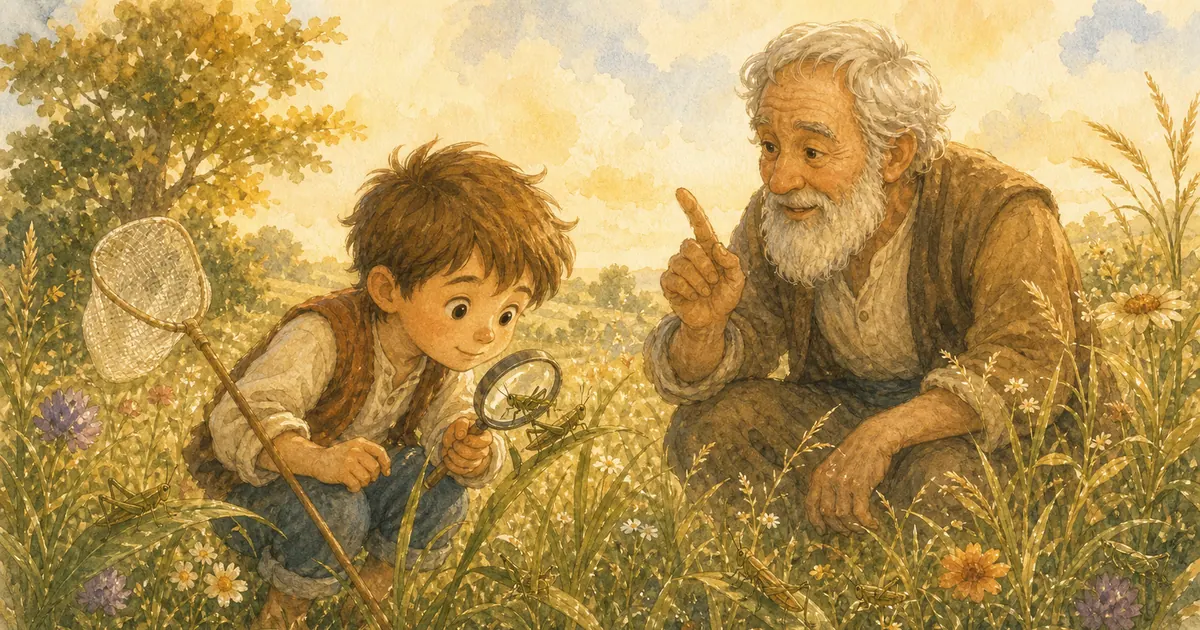
One clear afternoon, the grass beside the field stood high and thick, and locusts sprang here and there among the blades. A boy carried a small basket and bent low as he searched. Whenever he caught a locust, he dropped it carefully into the basket. With each catch he grew more pleased, thinking his eyes and hands were wonderfully quick.
Some locusts were green as new leaves, and some were brown as dry earth. They leaped suddenly and vanished in the shadows of the grass. The boy ran after them until his shoes were dusty and the backs of his hands were scratched by the sharp blades. Seeing his basket grow fuller, he became eager to add one more prize.
Then something moved beside a tuft of grass. The boy saw only a curved shape and thought it must be a large locust. He did not pause to wonder why it did not leap. He did not look closely at its body. Delighted, he stretched out his hand to seize it.
Just before his fingers touched it, the creature turned and lifted a stinging tail. It was not a locust, but a scorpion. “If you had touched me,” said the scorpion, “you would have lost not only me, but all your locusts too, for pain would have made you drop your basket.”
The boy sprang back, his heart beating hard. He held his basket firmly and looked again at the grass with slower eyes. He carried home many locusts that day, but he also carried home a wiser habit: before the hand reaches, the eye and the mind should examine what lies before them.
Read aloud
Uses the browser built-in speech engine.
Ready
Story takeaway
A hurried gain may become a greater loss when we act before looking carefully.
Talk together
What signs could have helped the boy notice that the scorpion was not a locust?
Source information
Aesop · Project Gutenberg legacy SQLite export
Public-domain fables and short tales exported from the legacy SQLite database.
From the same shelf
Read next
The Fox and the Grapes
狐狸與葡萄
A hungry fox fails to reach ripe grapes and calls them sour rather than admit his disappointment.
Read now
The Ant and the Grasshopper
螞蟻與蚱蜢
A grasshopper sings through summer while an ant stores food, then learns in winter that pleasure needs preparation.
Read now
The Lion and the Mouse
獅子與老鼠
A mighty lion spares a little mouse and later learns that even the smallest friend may give great help.
Read now